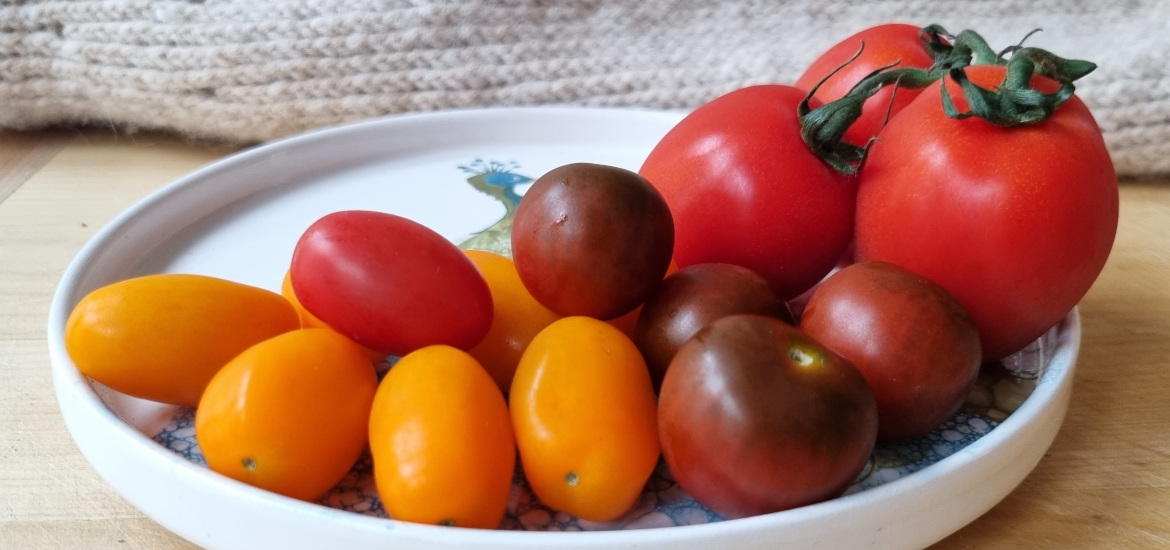
Every year, at the end of summer, there are a lot of unripe tomatoes in my garden. There are a number of ways which are suggested how to ripen them, but none worked for me. So similar to the kaki (persimmon) ripening process, I tried several variants to find the best one.
Ripening option 1
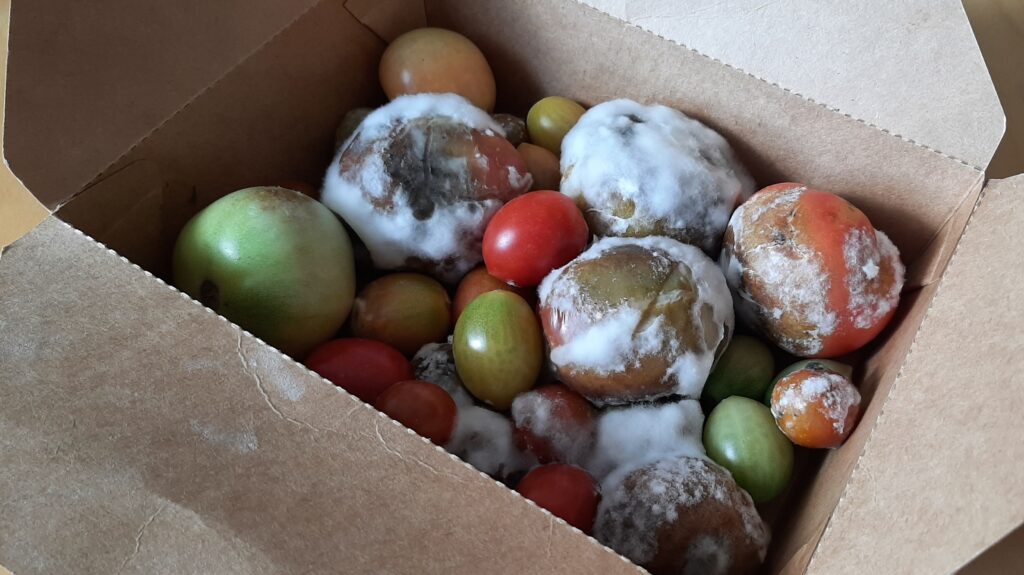
The first one was similar to kaki ripening. Just put unripe tomatoes and apples together in a box and check periodically. This method works to some extent, if you really check often. A couple of days of neglect and everything could be lost – just check the picture.
Ripening option 2
Then I tried a method that both of my grandmothers used. It is a fairly simple one. Just leave the tomatoes on a window ledge, facing the sun. The only requirement is that you have a sun facing ledge and that the sun is shining. Everyday as you go past, you can check the ripeness. Therefore there is no fear that the tomatoes will go bad. And since they are separated, you can easily pick out the one that is threatening to spoil it’s neighbors. The only downside to this method is that the sun must be shining. But this is not common for the end of the season, so this method has only partial usefulness.
Ripening option 3
There is a hybrid method that has some similarity to both methods mentioned above. It involves wrapping individual tomatoes in paper. Newspapers are especially useful. You do not need the sun, but you do need to check the tomatoes often. And if one of them spoils, the others are not affected. So it has some advantages, but again it is not perfect.
Ripening option 4
There is one more method that I am aware of. It gives fairly good results, but I am not exactly sure about the parameters. Leaving the unripe tomatoes in a cool, bright place apparently also does the trick. They do not spoil so rapidly and turn nicely red. But the taste leaves something to be desired. The problem is I am not sure about the temperature. It should not be too high and again not too low. As for the light, I am guessing it should be present, but not shining directly at the tomatoes.
This method definitely needs refining. While searching for more information, I found this useful site. It suggests the temperature is the main factor for the ripening, and that the optimal temperature is between 18-25 °C. I will definitely try this range in my future tests. Another important piece of the information is also that totally green tomatoes have a poor chance of ripening and should be therefore used directly in the recipes requiring green tomatoes.
Conclusion
Overall, all methods are useful to some extent, although they do not guarantee a perfect success. Usually about a half to two-thirds of all tomatoes ripen with each method. In the beginning of the autumn almost all of the tomatoes ripened, but later in the autumn this is not the case. This is expected, since the early tomatoes did receive more sun and were attached to the plant longer than the tomatoes picked at the end of the season. So, if you do decide to try to ripen the tomatoes, pick them early in the autumn for best results.
Related posts:
 The art of ripening a kaki (persimmon)
 How should I brew my coffee?
 Cream cheese tomato and salted fish sandwich
 Caffeine solubility, content in coffee beans and extraction
 Sea salt harvest
 Fudge and sugar crystals science
 Caffeine from coffee, tea, matcha, mate, guarana and soft drinks – is there any difference?
 Asterix’s magic potion
Great tips! I’ve found that tomatoes really respond to ethylene gas, which is what speeds ripening—so putting slightly green tomatoes in a paper bag with a ripe banana or apple can make a big difference. Keeping them at room temperature (not cold) also helps them turn red and flavorful faster. Thanks for sharing these practical methods!
Beautiful site! I really enjoyed exploring the content — it’s engaging and easy to read, and the visuals add a lot of charm. The posts feel thoughtful and well-organized, making it a pleasure to browse. Keep up the great work!
Great recipe! I’ve also shared a similar breakdown on my blog that might help your readers: CookWithAlixa.com. Thanks for the insightful post — loved the flavor tips!