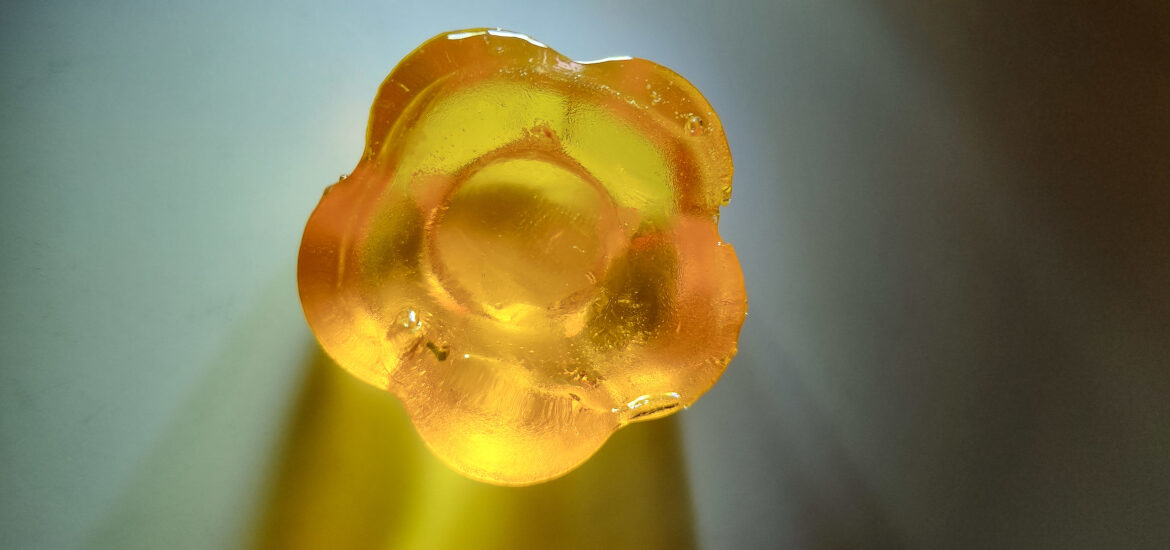
Recently a good friend asked me if I can make candies with liquid core. The first answer was a definite yes, since the science of making hard candy is not that complicated. You can even play around with it and make really good looking candies. But after consulting with the internet, the prospect was not so bright anymore. Mostly because there is practically no information on the methods of manufacturing candy with liquid core. Even the wikipedia entry about candy making does not include any reference to it. The best description of the process can be found in patents, and the preferred methods are either injecting the liquid core or co-extruding the core and the shell. Co-extrusion is probably hard to do in your kitchen, but liquid core not so much so I decided to give it a try.
Liquid core selection
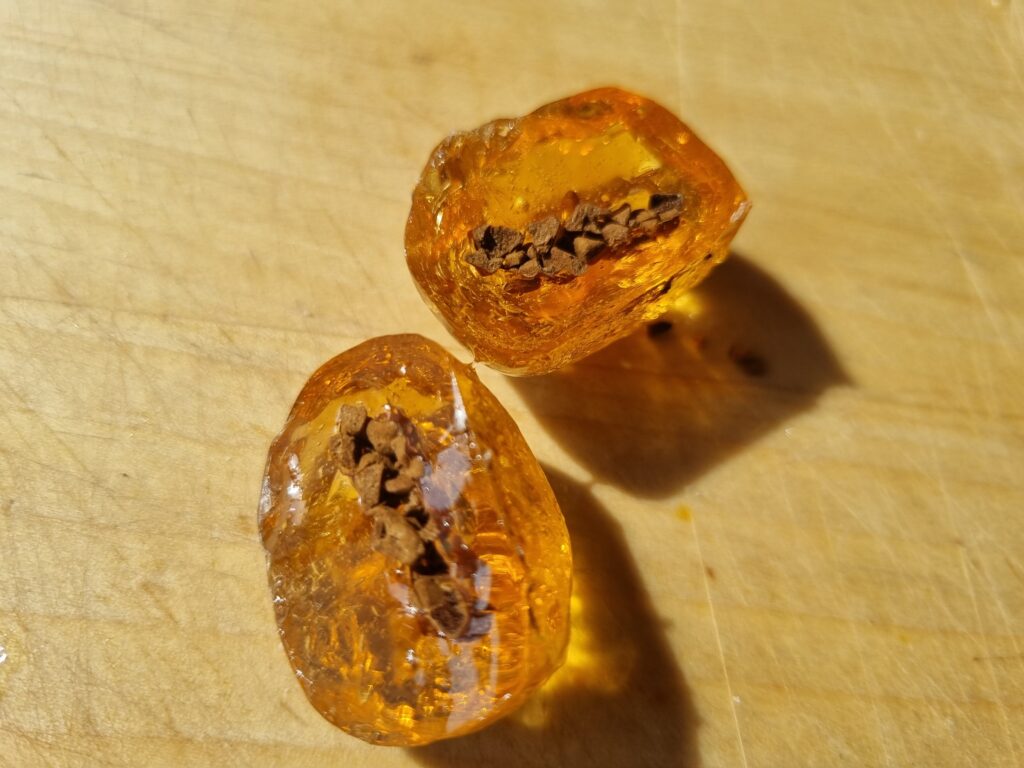
Obviously, water based liquids are not suitable as a liquid core, since they will dissolve the shell and leak out. Despite that, there are still plenty of options to choose from. First, you can inject flavored honey – a healthy and tasty option, resulting in sweets that can actually work as medicines. The next option for the liquid core is a saturated sugar solution in water (around 2g/mL at 20°C) – with or without flavors or colors. It is a good idea to add sugar in excess, to guarantee a saturated solution. For instance, you can cook your favorite tea, saturate it with sugar and fill it in candies. The options are truly limitless. An interesting idea is to fill alcohol infused cores, as described here, although this is intended for chocolate covering. It is also relatively simple – mix 100 g water, 42 g sugar, cook to 119 °C, cool down and add 35 g of your favorite liquor and you are done. There might be some issues with alcohol evaporating during the filling due to the relatively high temperature of the shell, but this remains to be tested. Finally you can stick to the recommendations from the patents. This includes use of more industrial materials like invert sugar, corn syrup solids and glycerin in the desired proportions. Naturally one can include flavors and colorings.
Shell formation and core injection – first try
Shell preparation is really easy – just follow the instructions for the simple candy. When the candy is poured into silicone molds in the last step, the core can be injected. To inject the core, a simple syringe with a needle is needed. Just make sure the needle is big enough for the core liquid to flow through easily. Do try it in advance, since viscous liquids, like honey can be tricky. And the needle should be made out of metal, since plastic can soften on melt when inserted into the shell at 150 °C.
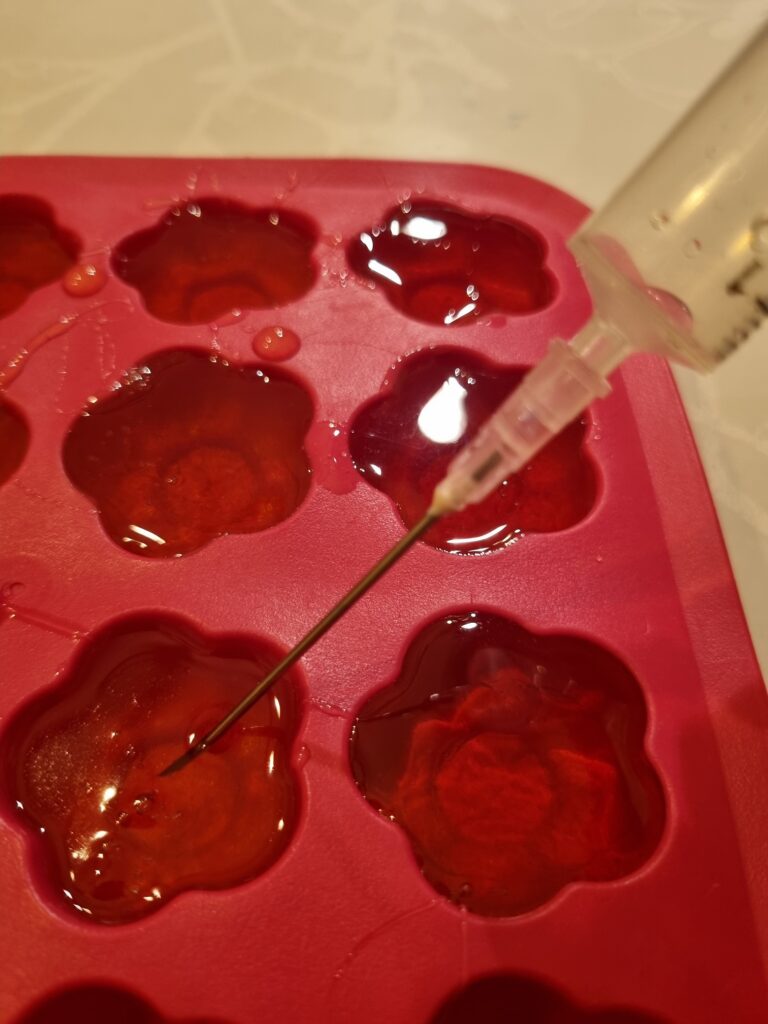
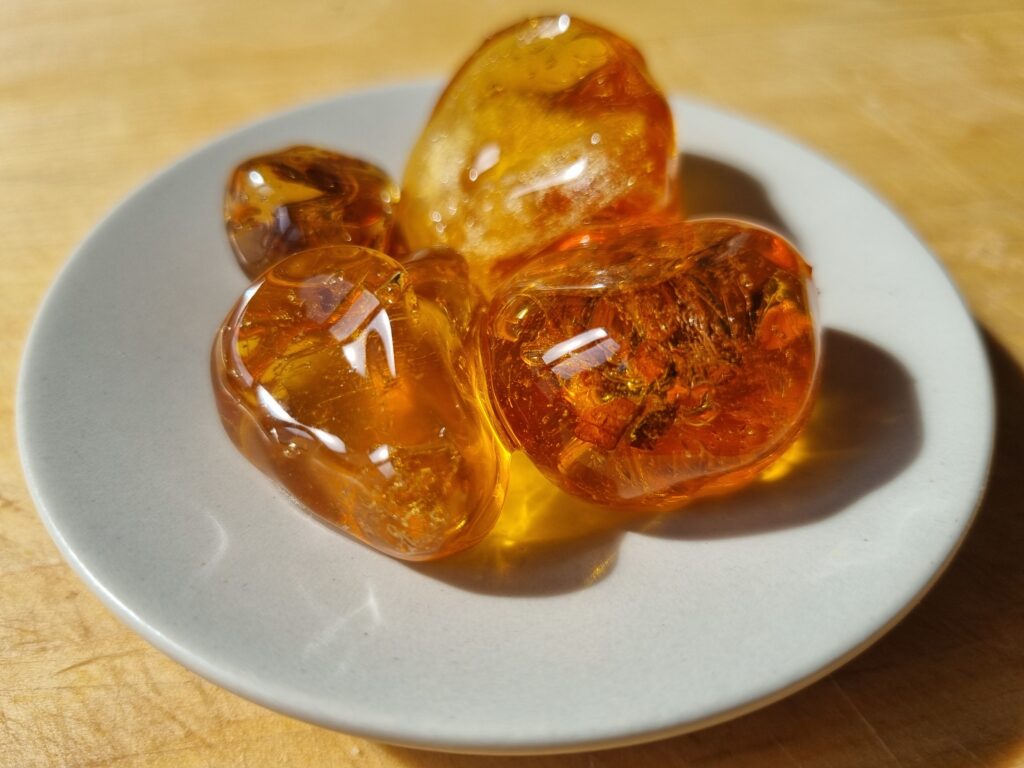
Well, the first try did not go as planned. I chose a saturated sugar solution for the core. It flowed perfectly through a needle, but it stuck to the needle and the whole core was pulled out of the candy when I tried to pull out the needle. Another thing was the difference in density between the core and the shell, since the core readily flowed to the top of the candy. The main mistake that I made was injecting the core too early. I injected the core immediately, which resulted in solidification of the shell around the core and sticking to the needle. Further, when the shell is cooler, it is much more viscous and does not allow the core to move in any direction. At least that is what I observed at the last injections. Finally, when the shell is cooler, a syringe without the needle can be used, since the temperatures are not that high anymore. I ended up with hard candies covered with the liquid core on the top. Not great, but I do believe that the next try will be a success.
Shell formation and core injection – second try
For the second try I waited for the shell to harden a bit and tried to inject the core at different timepoints. Not surprisingly, it turned out that the shell should be at an optimal temperature when you inject the core. Too hot and it is too liquid, so the core floats upwards, as it was obvious in the first try. If the shell is too cold (i.e. it does not flow when the mold is turned sideways) then the site of core injection does not close well and the core is leaking through the hole. And it is harder to inject the core since more force is needed to expand the shell and hence the core can leak at the injection site during the injection. Another important thing is the volume of the injected core. In my case 2 mL was way too much for approximately 10 mL of the shell. The top limit was around 1 mL, that is 10% of the shell volume, but I guess this also depends on the shape of the candy.
Shell formation and powder core injection
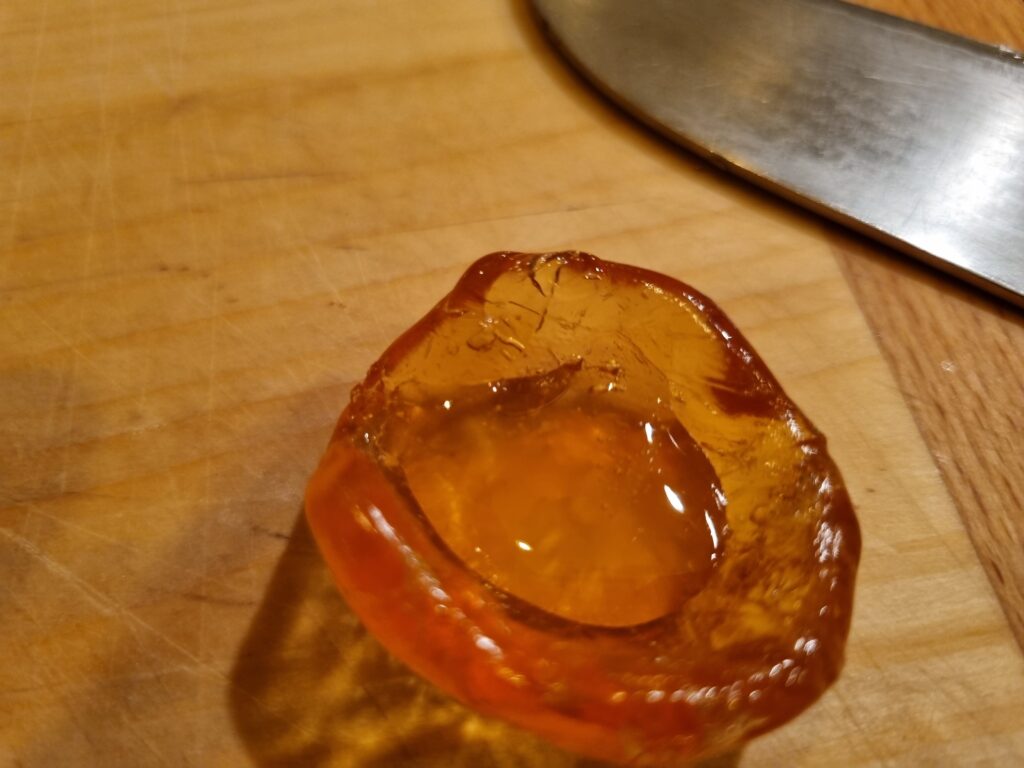
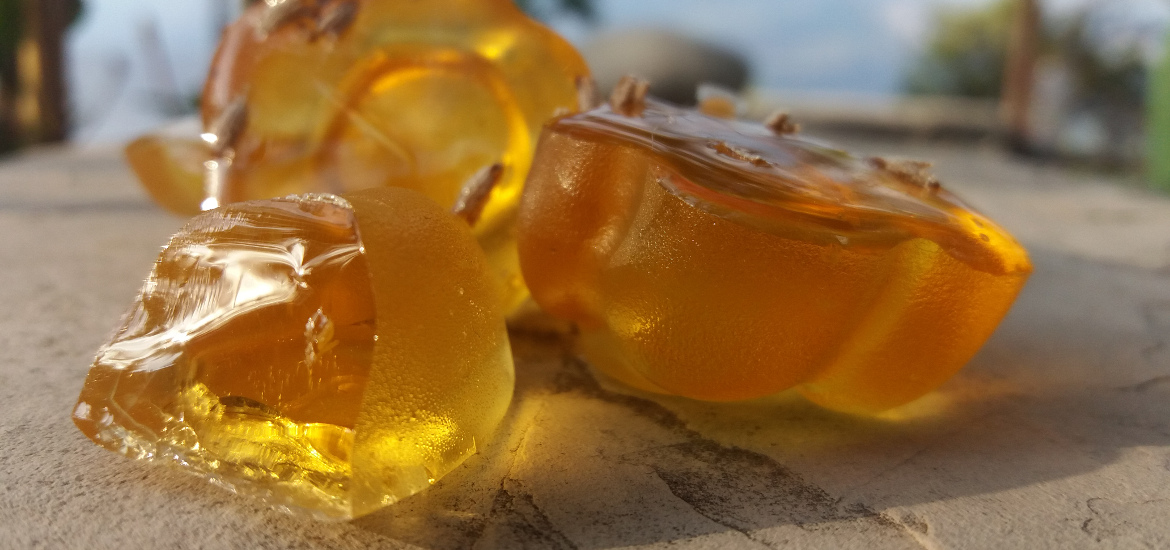
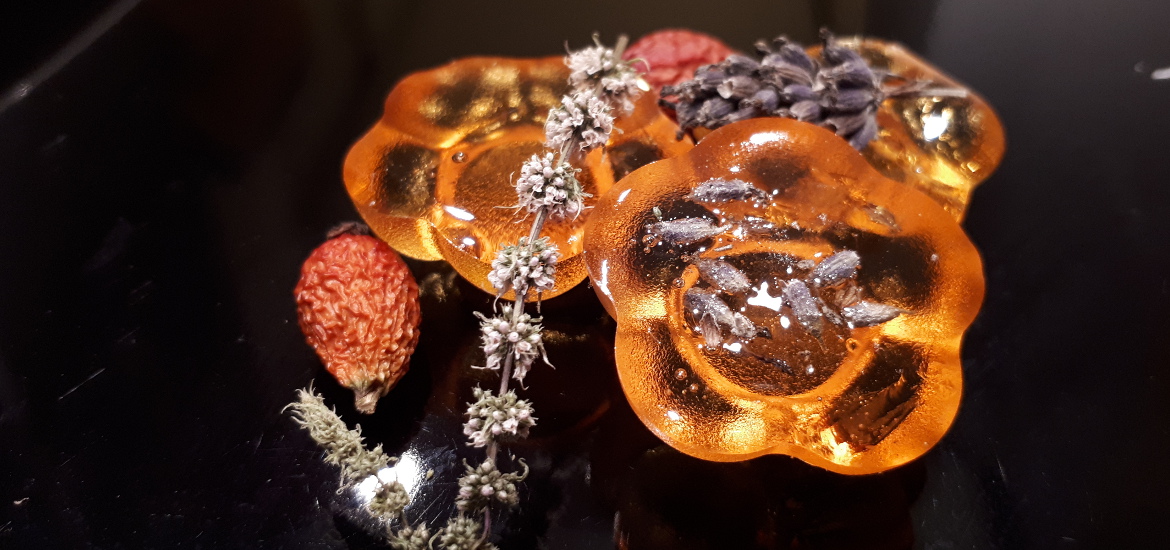
With all the issues with liquid core, I figured that solid core in the form of powder might be easier to make. Powder is much less mobile so it does not float around much and is also very versatile in terms of flavors or colors. The downside is that it is hard to inject since it does not flow. So my idea was to insert it between two core sheets. This proved to be hard to perform, since the sheets are difficult to form and handle. What emerged from this experience is that the shell is easiest to handle when it is cooled down to a dough consistency. In order to cool it down consistently, it has to be mixed by moving the edges, which are colder and harder, to the center of the mass, which is hotter and more liquid. When the shell has appropriate consistency, it can be cut by knife and shaped into bowl shape, which is filled either by powder or liquid and then the bowl is closed by moving the edges together. Maybe you will get a better idea from the picture. The result was good, I could encapsulate powder as well as honey. The only downside was that the candies were relatively big (approximately 3×2 cm), but definitely not too big.
Conclusion
Compared to simple hard candy, which is easy to make, filled candy is something different. Filling liquid cores with a syringe requires exact timing regarding the shell temperature together with exact location and volume of the core that is injected. Very hard to do on the first or second try and certainly not something that can be done on a large scale. On the other hand, preparing a mold with your hands is relatively easy. But the resulting candy is relatively big (definitely not too big) and again there is a problem of scale. You simply cannot make much candies before the shell mass solidifies beyond the limit of manipulation. In conclusion, you can make filled hard candy at home, but on a very small scale. But definitely enough to give yourself and your loved ones a sweet treat with an even sweeter core.